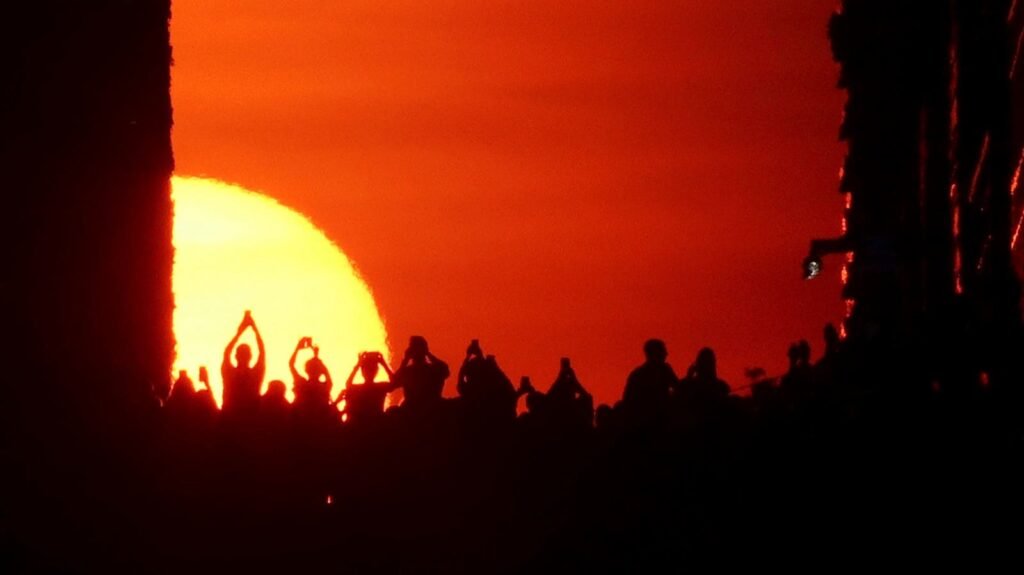

The setting sun moves across 42nd Street as people stand on the Pershing Square Bridge on Park Avenue during Manhattanhenge on July 13, 2018 in New York City. (Photo by Gary Hershorn/Getty Images)
Getty Images
New Yorkers are in for a rare double celestial treat this weekend as a “Blue Moon” coincides with the first “Manhattanhenge” sunsets of 2026.
On Thursday and Friday evenings, the setting sun will align perfectly with Manhattan’s famous street grid, while a seasonal Blue Moon will rise shortly after sunset on Friday — giving skywatchers a chance to witness two striking astronomical events within minutes of each other.
The combination is expected to draw photographers, tourists and locals onto Manhattan’s east-west streets for one of the city’s most iconic urban skywatching spectacles.
What Is ‘Manhattanhenge?’
“Manhattanhenge” occurs when the setting sun aligns precisely with Manhattan’s grid of streets, creating the illusion of the sun suspended between rows of skyscrapers.
The phenomenon happens because Manhattan’s grid is rotated about 30 degrees east of true north. As the sunset position migrates northward, approaching the summer solstice, there are four evenings each year when the geometry aligns perfectly with the streets.
According to the American Museum of Natural History, the first 2026 dates are:
- Thursday, May 28, at 8:14 p.m. EDT — “half sun on the grid.”
- Friday, May 29, at 8:13 p.m. EDT — “full sun on the grid.”
The “half sun” event is often considered the more photogenic moment because the sun appears to “kiss the grid,” with half the solar disk dipping below the horizon. On the following evening, the entire disk appears framed between the buildings just before sunset.
What Is A Seasonal ‘Blue Moon?’
The second celestial event this weekend is a seasonal Blue Moon — the third full moon in a season containing four full moons.
Unlike the phrase “once in a blue moon” suggests, Blue Moons are not especially rare. Seasonal Blue Moons occur roughly every two to three years, though pairing one with Manhattanhenge creates an unusually photogenic skywatching weekend.
The moon itself will not appear blue in color. Instead, observers can expect to see a bright full moon rising in the southeast after sunset, complementing Manhattanhenge’s golden-orange glow earlier in the evening. The full moon will, of course, occur on the opposite side of the sky to the setting sun. After all, that is why it is full.
Where To See Manhattanhenge
The best views are from Manhattan’s broad east-west thoroughfares with unobstructed views toward New Jersey across the Hudson River.
Recommended locations include:
- 14th Street
- 23rd Street
- 34th Street
- 42nd Street
- 57th Street
The American Museum of Natural History also recommends the Tudor City Overpass in Manhattan and Hunter’s Point South Park in Queens.
Neil deGrasse Tyson, who popularized the term “Manhattanhenge,” has previously described 34th and 42nd Streets as especially dramatic because of views framed by the Empire State Building and Chrysler Building.
Why Manhattanhenge Happens
The event is ultimately caused by Earth’s tilted axis and the changing position of the sunset throughout the year.
“The sunset point actually creeps day to day along the horizon,” explains the American Museum of Natural History. The sun sets due west only on the equinoxes in March and September. At all other times of the year, its setting position shifts north or south.
As the summer solstice approaches, the sunset point moves farther northwest each evening. Because Manhattan’s grid is angled 30 degrees from true north, the alignment occurs in late May and again in July rather than exactly on the solstice itself.
For many New Yorkers, however, the science is secondary to the spectacle — a brief moment when the city’s architecture and the movements of the solar system appear perfectly synchronized. Prepare for crowds.
The ‘Manhattanhenge Effect’
Manhattanhenge is not limited to just two evenings each year. The sun gradually moves through the grid system over several weeks, creating a “Manhattanhenge Effect.” Beginning in late May and continuing through July 12, sunset viewers can observe the sun changing position slightly each evening. Before the summer solstice, the sun appears progressively farther north at sunset. After the solstice, it slowly shifts southward again, eventually recreating the precise Manhattanhenge alignment in July.
The result is a 45-day period of dramatic sunsets that transform Manhattan into a natural solar observatory.
Wishing you clear skies and wide eyes.


