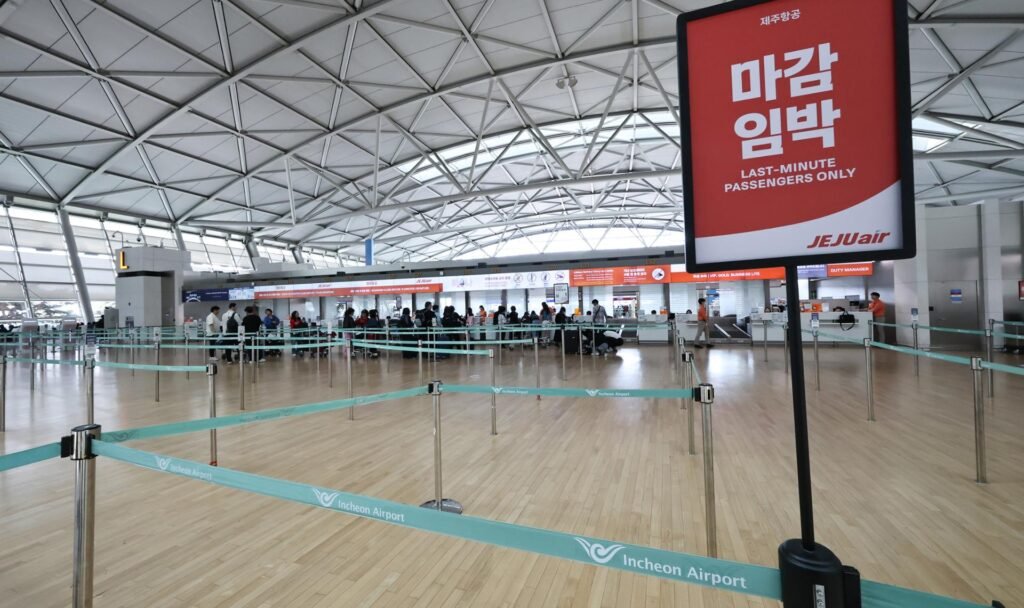
Check-in counters for Jeju Air at Terminal 1 of Incheon International Airport remain nearly empty, Sunday. Yonhap
Mounting fuel costs and weakening travel demand are sparking concerns of sweeping restructuring across Korea’s low-cost carrier (LCC) industry, as budget airlines slash international flights, expand unpaid leave programs and implement emergency cost-cutting measures to weather intensifying financial pressure.
The aviation sector has come under strain from a combination of soaring global oil prices and a weakening Korean won, with budget carriers bearing the brunt of the impact.
Industry officials said the sharp rise in aviation fuel prices — triggered by escalating instability in the Middle East — has rapidly increased operating costs for LCCs, and the rising ticket prices are dampening consumer demand.
Roughly 900 round-trip international flights have already been cut, largely among LCCs, amid the armed conflict in the Middle East. The figure is expected to rise further as travel demand weakens.
The jets of low-cost carriers are seen at Incheon International Airport, July 8, 2024. Newsis
Airlines are increasingly trimming less profitable routes, as fuel expenses — one of the largest components of airline operating costs — continue to climb sharply.
Despite higher fuel surcharges, carriers continue to struggle with elevated costs. Jin Air suspended 131 flights on 14 routes this month, after canceling 45 round-trip flights on eight routes last month. Air Premia plans to suspend a total of 73 flights until August.
Airlines are also rapidly reshaping route strategies. Budget carriers are increasingly expanding short-haul China routes, where lower fuel consumption and quicker aircraft turnaround times offer operational advantages.
Parata Air recently secured routes linking Incheon with Shenzhen, Chengdu and Chongqing, while Eastar Jet obtained rights for routes connecting Incheon and Xiamen and Hohhot.
Concerns over broader restructuring have intensified, as airlines increasingly adjust workforce operations.
Aero K recently began accepting applications for unpaid leave from all employees, becoming the second LCC after T’way Air to introduce such measures. T’way Air is offering temporary unpaid leave to cabin crew members for May and June. Last week, Jeju Air also shared its plan to accept applications for unpaid leave from cabin crew next month.
Industry officials warn that if elevated oil prices persist, structurally weaker airlines could face intensifying liquidity and survival risks despite short-term measures, such as cost-cutting, capital expansion and route optimization.
“Most LCCs are forecast to report deficits in the second quarter when they are exposed to the full impact of the oil price hike,” an official from the industry said.
“Budget carriers have no choice but to tighten their belts, and engage in emergency management by closely monitoring the external uncertainty, but the outlook remains murky due to the prolonged conflict in the Middle East.”
According to data from market tracker FnGuide, a combined operating loss among Jeju Air, Jin Air, T’way Air and Air Busan is forecast to reach 244.7 billion won ($167 million) in the second quarter of the year.