While the Geographic North Pole is one of the hardest of all adventure destinations — so difficult that it has not been done on foot for 12 years — the North Magnetic Pole is now even harder.
That wasn’t always the case. In the 1980s and 1990s, the North Magnetic Pole lay a reasonable 650km north of the Canadian hamlet of Resolute Bay. As the last stop of jets from the south, Resolute was relatively easy to reach. Although its population was only 200, mostly Inuit, it had three hotels. You could start skiing to the Magnetic Pole from just outside your hotel room.
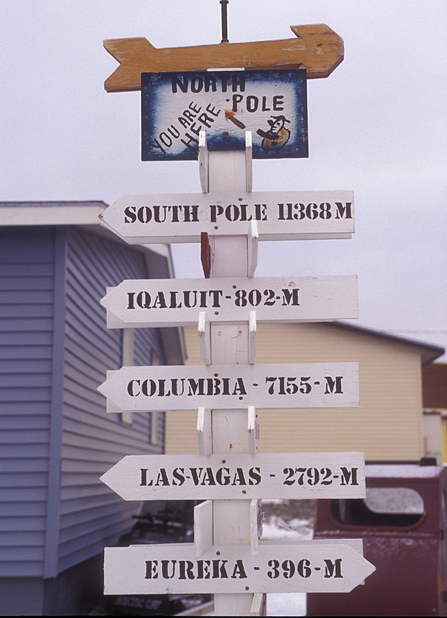
An old signpost with two misspellings outside a Resolute hotel. Photo: Jerry Kobalenko
In that era, it often served as a shakedown trip for expeditions to the more difficult Geographic Pole. It introduced the mostly European skiers to the sort of cold you couldn’t find in Lapland. It was on sea ice, but not difficult sea ice like that on the Arctic Ocean. Nice flat stuff. And it forced skiers to prepare to meet polar bears for the first time. At the end of the journey, a ski-equipped Twin Otter aircraft landed on the sea ice and ferried you back to Resolute.
Navigational difficulties
One of the main difficulties for the earliest Magnetic Pole expeditions was navigation. The compass did not work, even in Resolute. The magnetic lines of force were almost vertical and had such a small horizontal component that a compass needle just spun slowly, sluggishly, as if in clear molasses, never settling on one bearing. (Note that it did not try to point vertically into the ground; it was just indecisive.) Handheld GPS devices became popular only around 1990, but until then, adventurers had to rely solely on maps.
For those with more modest ambitions, the North Magnetic Pole was an end in itself. At least a couple of early skiers tried to bamboozle the public by announcing that they had skied to “the Pole” or “the North Pole.” They rightly assumed that most media and readers would not know the difference. Nevertheless, the two are not the same.
The Geographic North Pole is the point at the top of the world at 90˚ latitude. All the lines of longitude converge there. It lies in the middle of the Arctic Ocean, just over 700km from land. Although Greenland extends slightly farther north, most ski expeditions began from the north coast of Ellesmere Island because the ocean currents are not as bad there.
The Russia start
A few launched from Russia, which was a little farther from the Geographic Pole and featured troublesome open water at the start. (In 2004, one woman soloist died when she fell into the ocean.) But once you got beyond that, the currents were with you. Meanwhile, skiers from Ellesmere had to accept that every time they slept, they would lose a few kilometers, as the ice they were on drifted back toward land. Skiing north from Ellesmere was like walking up a down escalator.
The Geographic Pole never changes its position, although the skin of sea ice atop the Arctic Ocean drifts constantly.
On the other hand, the North Magnetic Pole is the point at which the planet’s magnetic field points vertically downward. It constantly changes its position as the Earth’s molten core swirls unseen. For over 150 years, since its discovery in 1831 by British explorer James Clark Ross, it crept north a few kilometers a year. But then in the mid-1990s, it began to go on a tear, which has continued.

It is now more than halfway across the Arctic Ocean, beyond the North Pole, closer to Siberia. Rather than an easy alternative to the Geographic Pole, it is now even harder to reach. No one has skied to the North Magnetic Pole in almost 30 years since it began its sprint. I don’t think anyone has even tried.
Magnetic Pole ‘races’
The old, convenient location of the North Magnetic Pole continued to be a draw for a while. In 1996, two organizers led some novice skiers to the Magnetic Pole. By 2003, it was well on its dash to Russia, but from 2003 until 2011, two UK groups organized annual or biannual team races from Resolute to the old site of the North Magnetic Pole.
In the early years, if I recall, they may have been a little casual with their advertising, continuing to call their destination the North Magnetic Pole. Eventually, though, as the Magnetic Pole receded further away (and compass functionality returned to Resolute), it became a race to “the 1996 location of the North Magnetic Pole.”
In the end, the route from Resolute to just off Ellef Ringnes Island, where that invisible point once briefly stood, has become the lone High Arctic route that has seen dozens of participants. Although rarely done anymore, it remains the northern version of Antarctica’s well-worn Hercules Inlet to the South Pole.
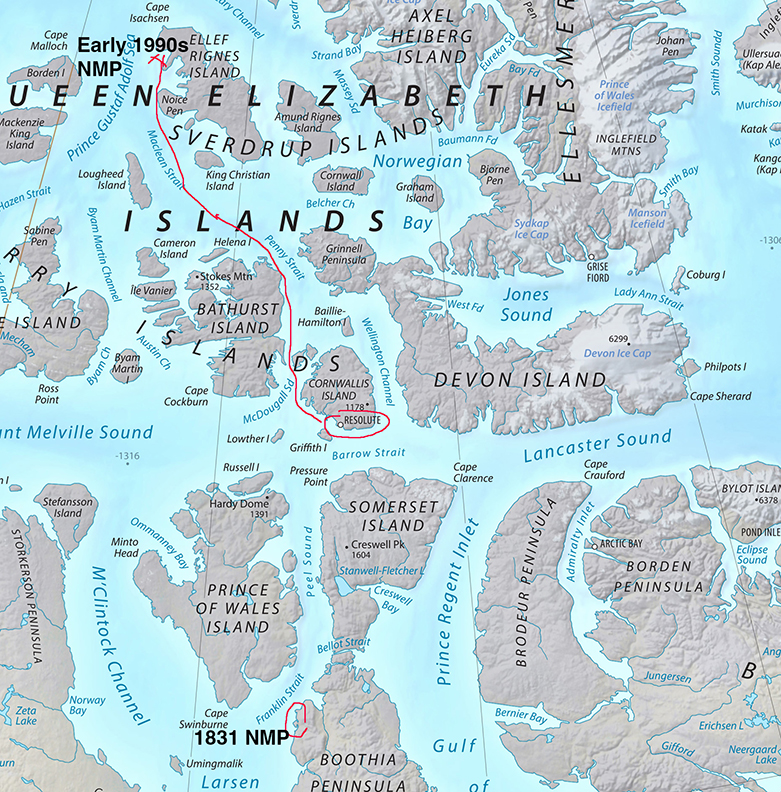
Route from Resolute to the old location of the North Magnetic Pole, in red. A few years earlier, the NMP was in the middle of Mclean Strait, between Lougheed and King Christian Islands. When first discovered in 1831, the NMP was much further south, on the west side of the Boothia Peninsula.


